InfluxDB for IIoT and Predictive Maintenance
#1
Time Series Database
Source: DB Engines

1B+
Downloads of InfluxDB
Turning sensor telemetry into real-time insight
Industrial data creates real value only when high-resolution telemetry is used to monitor assets and control processes in real-time.
InfluxDB is the foundation that makes this possible at scale. It ingests and stores millions of unique time series at sub-second resolution, while cost-effectively storing the historical context to power predictive maintenance, anomaly detection, and advanced operational analytics.
Purpose-built for Industrial IoT

Ingest at Scale
Ingest millions of series per second from sensors, PLCs, SCADA systems, and other sources of telemetry.

Real-Time Querying
Query millions of series across long time ranges, with sub-10ms latency.

Unified Operational Visibility
Consolidate data from legacy systems and historians into a single source of truth for IIoT data.

Cost-Effective Scaling
Scale economically with efficient compression and storage to keep costs in check.





Time series powers every Industrial IoT system
InfluxDB is the proven, real-time foundation for mission-critical IIoT analytics at scale. Global leaders in manufacturing, energy, utilities, and industrial automation depend on its extensibility and developer-friendly platform to connect OT and IT, and drive real-time automation.

Preventing Costly Downtime in Manufacturing
Olympus Controls (part of Applied Automation) uses InfluxDB to monitor robot health in real-time, spotting early signs of wear and scheduling maintenance before costly outages occur. By turning high-resolution machine telemetry into immediate insight, Olympus helps manufacturers reduce downtime and keep production lines running smoothly.
Watch webinar
Supporting Distributed Energy Resources
Scottish Power Energy Networks (SPEN) replaced its legacy data historian with InfluxDB to handle the surge in data volume and high-cardinality metadata driven by the adoption of distributed energy resources (DERs). InfluxDB unifies analog telemetry and digital event data in a single platform, delivering real-time insights and fulfilling strict regulatory reporting requirements.
Watch webinar
Predictive Maintenance at Global Scale
Siemens Energy uses InfluxDB to monitor 23,000 battery modules across 70+ sites, analyzing billions of high-frequency sensor readings instantly to ensure quality, prevent downtime, and keep production running anywhere in the world.
Read announcement
Real-Time Monitoring for Smarter Energy Storage
ju:niz Energy builds large-scale battery storage systems and intelligent energy management solutions. It streams thousands of sensor data points every second, tracking battery health, temperature, and more, to power real-time monitoring, predictive maintenance, improved sustainability, and support the adoption of renewable energy.
Watch webinar
From Zero Automation to Full Industrial Observability
The City of Morro Bay, California, uses InfluxDB to stream and analyze real-time data across an upgraded water treatment system, bringing a 1960s-era treatment plant into the digital age. High-frequency metrics from pumps, tanks, valves, and power systems enable secure and reliable monitoring, as well as rapid response. By turning continuous telemetry into actionable insight, the city achieved efficient, cost-effective operations and full industrial observability.
Watch webinarOlympus Controls (part of Applied Automation) uses InfluxDB to monitor robot health in real-time, spotting early signs of wear and scheduling maintenance before costly outages occur. By turning high-resolution machine telemetry into immediate insight, Olympus helps manufacturers reduce downtime and keep production lines running smoothly.
Watch webinar
Scottish Power Energy Networks (SPEN) replaced its legacy data historian with InfluxDB to handle the surge in data volume and high-cardinality metadata driven by the adoption of distributed energy resources (DERs). InfluxDB unifies analog telemetry and digital event data in a single platform, delivering real-time insights and fulfilling strict regulatory reporting requirements.
Watch webinar
Siemens Energy uses InfluxDB to monitor 23,000 battery modules across 70+ sites, analyzing billions of high-frequency sensor readings instantly to ensure quality, prevent downtime, and keep production running anywhere in the world.
Read announcement
ju:niz Energy builds large-scale battery storage systems and intelligent energy management solutions. It streams thousands of sensor data points every second, tracking battery health, temperature, and more, to power real-time monitoring, predictive maintenance, improved sustainability, and support the adoption of renewable energy.
Watch webinar
The City of Morro Bay, California, uses InfluxDB to stream and analyze real-time data across an upgraded water treatment system, bringing a 1960s-era treatment plant into the digital age. High-frequency metrics from pumps, tanks, valves, and power systems enable secure and reliable monitoring, as well as rapid response. By turning continuous telemetry into actionable insight, the city achieved efficient, cost-effective operations and full industrial observability.
Watch webinar
Open connectivity from edge to cloud
InfluxDB streams machine and sensor data across plants, production lines, and field assets using open protocols and 300+ Telegraf integrations. Connect PLCs, SCADA systems, and modern analytics tools without vendor lock-in, so operations, engineering, and IT teams can access high-frequency time series data anywhere it’s needed.
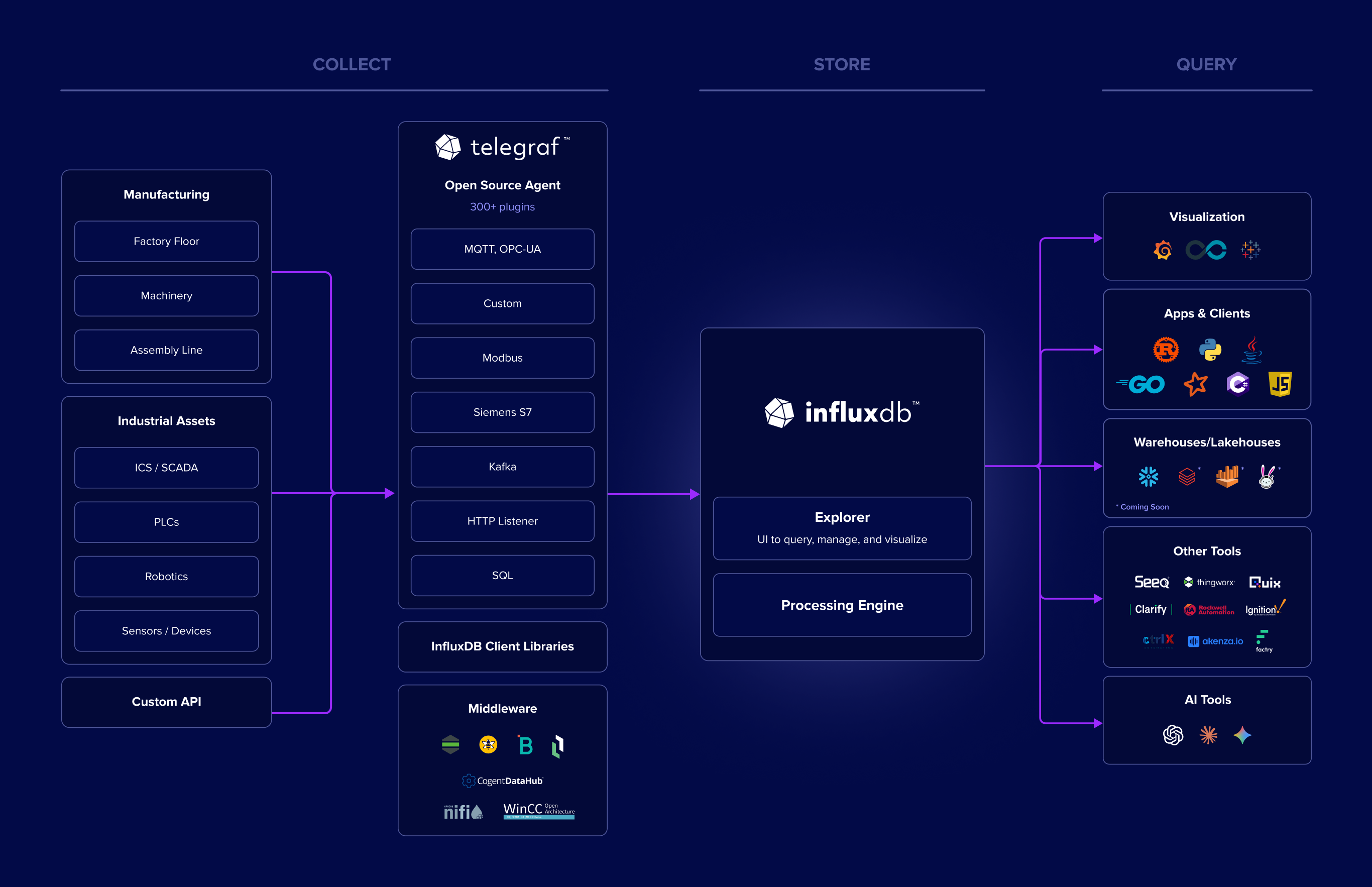
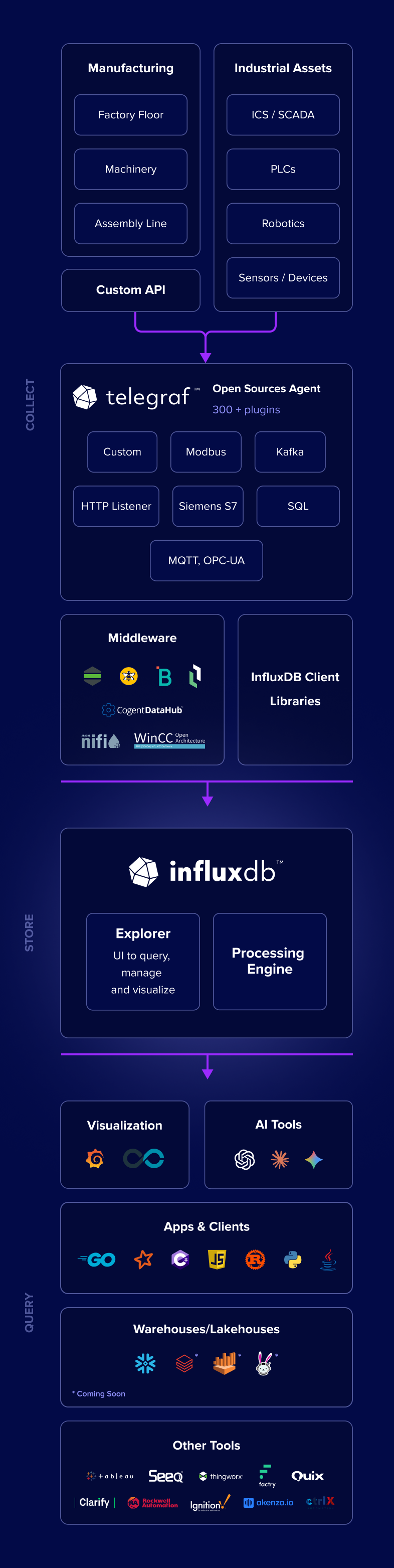
Deploy anywhere
Whether you're building on-prem, private cloud, edge, or multi-tenant cloud, InfluxDB meets developers where they are.
Additional resources

Time Series Buying Guide for IIoT
All machinery, equipment, and their controls and sensors tell a story through the data they collect. This data, known as Industrial Internet of Things (IIoT) data, provides a clear narrative about the machines and offers insights on how to improve operations.
Learn more
Industrial IoT for Energy | Live Demonstration
In this live technical demo, discover through real-life use cases how energy companies use InfluxDB in their production-ready environments to support predictive maintenance of critical infrastructure, optimize energy generation and distribution, and improve grid reliability.
Learn more
Power Your Predictive Analytics with InfluxDB
Dive into using InfluxDB with Quix and Hugging Face to move from simply storing IoT time series data to building predictive analytics. Learn how to create real-time dashboards, detect anomalies, and forecast trends for IoT predictive maintenance.
Watch webinarFAQ
Trial for Free
Start free with self-managed, our most popular setup.
Easily install for Linux, Mac, RHEL, Docker:
curl -O https://www.influxdata.com/d/install_influxdb3.sh && sh install_influxdb3.sh enterprise
For Windows installation, see the Getting Started Guide.
By default, trials are 30 days. Need more time? We can help extend it. Contact Us.


